How to read a Certificate of Analysis
What each section of a COA actually proves, which fields suppliers commonly omit, and the eight checks that separate a real COA from a marketing document.
Resources
Most suppliers publish a purity number and stop. These are the documents we wish every supplier published — written for people who actually have to evaluate a lot.
What each section of a COA actually proves, which fields suppliers commonly omit, and the eight checks that separate a real COA from a marketing document.
Lyophilized versus reconstituted stability, freeze-thaw effects, light and moisture sensitivity, and how to store each compound class in your own facility.
HPLC, mass spec, LAL endotoxin, USP <71> sterility and fill-weight verification — what each one answers and why a purity figure alone is not enough.
Solid-phase peptide synthesis, cleavage and deprotection, preparative HPLC purification, lyophilization and controlled fill — the twelve documented steps.
Purity specifications, testing, international shipping, wholesale minimums and the research-use-only framework we operate under.
Commission tiers, cookie window, payout schedule, and the content rules every partner agrees to when promoting research-use-only materials.
Specification glossary
| Term | What it means | Why it matters |
|---|---|---|
| HPLC | High-performance liquid chromatography — separates a sample into its components by how strongly each interacts with the column. | The purity figure. Area under the main peak as a percentage of total peak area. |
| RP-HPLC | Reverse-phase HPLC. Non-polar stationary phase, polar mobile phase — the standard method for peptides. | Method matters: purity figures are only comparable when the method is. |
| MS / m/z | Mass spectrometry. Reports the mass-to-charge ratio of the ionised molecule. | Confirms identity. Without it, a purity number describes an unknown. |
| LAL | Limulus amebocyte lysate assay — detects bacterial endotoxin (LPS). | LPS confounds any cell-based or immunological assay at picogram levels. |
| EU/mg | Endotoxin units per milligram — the unit of an LAL result. | Lower is better. Look for a number, not the word "tested". |
| USP <71> | United States Pharmacopeia sterility test chapter. | A named standard, not a vague "sterile" claim. |
| TFA | Trifluoroacetic acid — the ion-pairing agent used in peptide purification. | Residual TFA affects cell viability assays. Ask for residual solvent data. |
| Net peptide content | Proportion of vial mass that is actually peptide, excluding counterion and water. | Distinct from purity. A 99% pure peptide can be 80% net peptide by mass. |
| Lyophilized | Freeze-dried under vacuum from a frozen aqueous solution. | The standard stable form for peptide shipping and storage. |
| ISO/IEC 17025 | Accreditation standard for testing and calibration laboratories. | The lab itself is audited — not just the result reported. |
| cGMP | Current Good Manufacturing Practice. | A documented, inspectable production quality system. |
| Lot / batch | A single production run with its own records and COA. | Traceability. A COA that is not lot-specific proves nothing about your vial. |
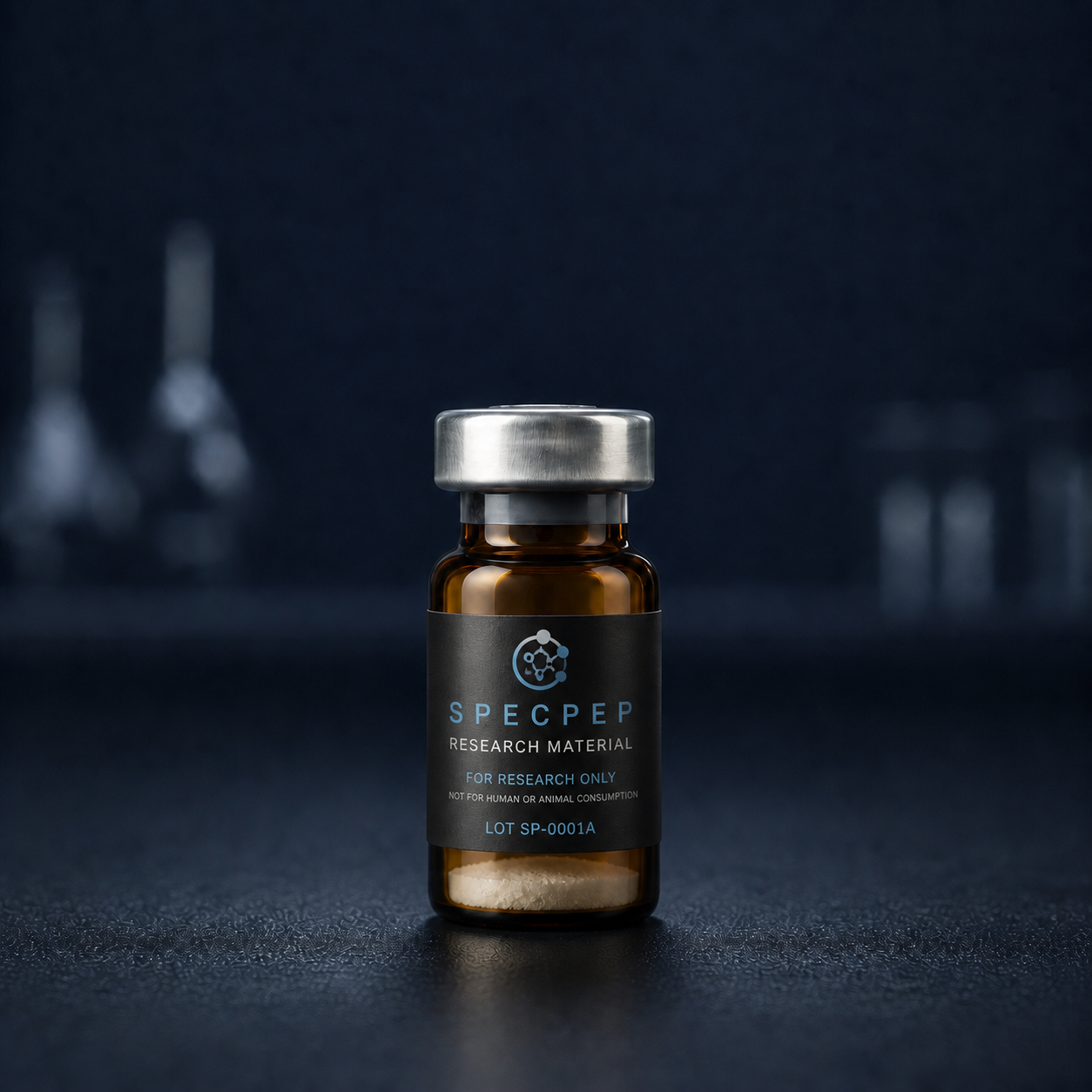
Research material
No dosing, therapeutic, clinical or personal-use information is provided.
COA lookup
Enter a lot number to request its documentation from the SpecPep quality team.
Documentation list
Research materials
SpecPep supplies materials exclusively for lawful laboratory and analytical research. They are sold in lyophilized form, require reconstitution by qualified personnel, and are not for human or animal consumption, clinical, diagnostic, therapeutic, cosmetic or veterinary use. No dosing or usage instructions are provided.